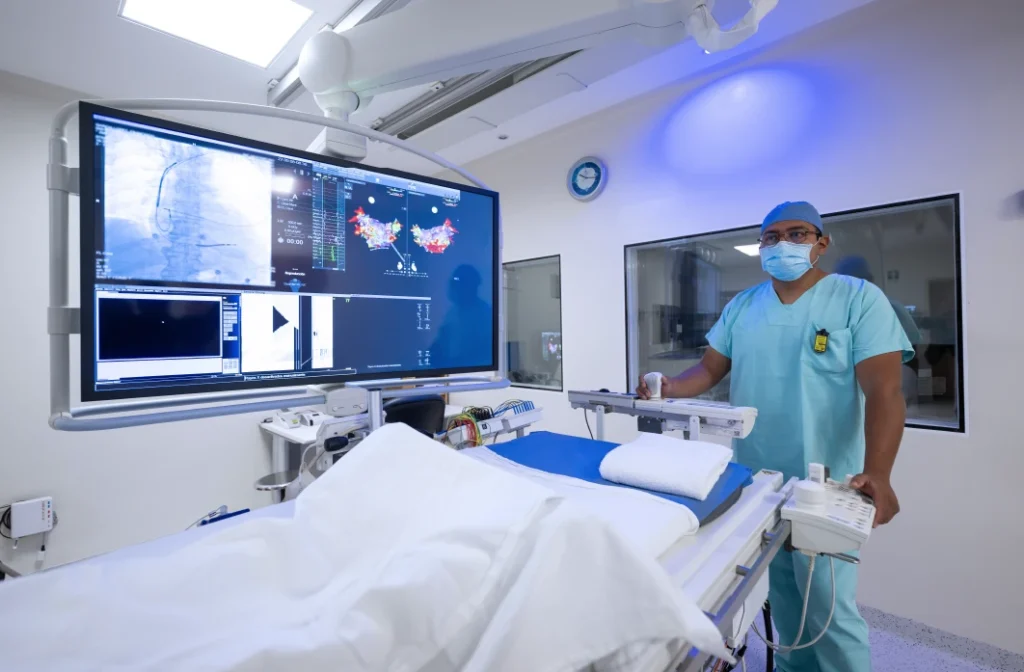
The CARTO system is an advanced electroanatomical mapping technology used in cardiac ablation procedures, particularly for addressing complex arrhythmias such as atrial flutter or atrial fibrillation.
Types of Arrhythmias
Arrhythmias occur when the electrical impulses that coordinate heartbeats are abnormally fast, irregular, or originate from sites outside the heart’s normal conduction system. This causes tachycardia (a heart rate that is too fast), bradycardia (a heart rate that is too slow), or an irregular rhythm.
Arrhythmias can affect individuals of any age, from children to older adults. They manifest differently in each person, presenting as palpitations, a skipping sensation in the chest, heart racing, dizziness, shortness of breath, or even loss of consciousness or fainting.
What Is an Ablation?
Cardiac ablation is a minimally invasive medical procedure used to treat arrhythmias. It involves delivering energy—either radiofrequency (heat) or cryoablation (cold)—to eliminate or isolate areas of heart tissue that generate or conduct abnormal electrical signals.
Ablation is performed using a catheter inserted through blood vessels to the heart, guided by electroanatomical mapping techniques such as the CARTO system.
CARTO-Guided Ablation at Centro Médico ABC
Up to 80% of cardiac arrhythmias can be treated with catheter ablation, eliminating the need for long-term medication. This procedure creates microscopic scars in the areas of the heart involved in rhythm disorders. While many arrhythmias can be treated with conventional mapping systems, complex arrhythmias require 3D electroanatomical mapping, known as the CARTO system.
CARTO is a specialized 3D electroanatomical reconstruction system that enables real-time navigation inside the heart chambers with exceptional precision and without the need for fluoroscopy.
Because it does not rely on X-rays, the use of CARTO minimizes radiation exposure for the patient—or eliminates it entirely when using the "zero-fluoroscopy" approach.
Using the CARTO system, specialists can reconstruct the heart’s chambers and use the resulting image as a "GPS map," pinpointing the exact origin of arrhythmias to facilitate their elimination.
The CARTO system uses catheters equipped with location sensors to automatically and simultaneously record electrograms and coordinates at each position. This creates a 3D electroanatomical map of the heart chamber where the arrhythmia originates, providing critical real-time information for the ablation.
CARTO provides detailed insights into electrophysiological rhythm disturbances by identifying areas of early activation, reentrant circuits, or fibrosis (scar tissue). This makes it an indispensable tool for catheter ablation of conditions like atrial fibrillation and ventricular tachycardia. Approximately 2% of the global population lives with atrial fibrillation, and the CARTO system is essential for its treatment.
Common conditions managed with CARTO include:
- Atrial fibrillation (paroxysmal, persistent, or permanent)
- Atypical atrial flutter (and select cases of typical flutter)
- Frequent atrial premature contractions (ectopic beats)
- Atrial tachycardia
- Frequent or highly symptomatic premature ventricular contractions (PVCs)
- Ventricular tachycardia (of any etiology)
During radiofrequency (heat-based) cardiac ablations supported by CARTO, several catheters are introduced through the groin. The millimeter-sized tip of the ablation catheter cauterizes the targeted inner surface of the heart to cure the arrhythmia.
Centro Médico ABC offers radiofrequency ablation via the CARTO system updated with the latest software versions to deliver optimal outcomes for patients.
These procedures are performed by renowned electrophysiologists—cardiologists who have completed subspecialty training in electrophysiology. They specialize in identifying and treating arrhythmias through high-resolution mapping systems like CARTO and interventional procedures like cardiac ablation. All electrophysiologists on staff at Centro Médico ABC are certified and current with the Mexican Board of Cardiology, ensuring professional excellence.
Benefits of the CARTO System
Undergoing cardiac ablation using the CARTO system offers several advantages:
- Minimally Invasive: Performed via catheter access through the groin.
- Reduces or Eliminates Medication: 80% of cardiac arrhythmias can be successfully treated, often removing the need for lifelong drug therapy.
- Dramatically Reduces Radiation: Eliminates or significantly minimizes X-ray exposure by tracking catheters electronically.
- Quick Recovery: The procedure takes approximately four hours and typically requires only an overnight hospital stay.
Cardiac ablation procedures are performed at both our Observatorio and Santa Fe campuses in dedicated, hybrid operating suites designed for minimally invasive catheter-based interventions.
At the Cardiac Catheterization Unit at Centro Médico ABC, we provide specialized care. Contact us today!