Contact us
Precision Medicine
4 November 2025
Sick sinus syndrome, also known as sinus node dysfunction, is a rare disorder that affects the heart’s rhythm. It damages the sinus node, which is responsible for keeping the heart’s beats steady and regular.
Sick sinus syndrome is characterized by slow, irregular, and paused heartbeats, but episodes of rapid heartbeats can also occur.
Sick sinus syndrome generally appears in people over 50 years old and can arise from various factors, including:
In this disorder, the sinus node does not function properly, resulting in heart rhythm abnormalities such as bradycardia (a slow heart rate), prolonged pauses between beats, or alternating episodes of slow and fast rhythms, known as tachycardia-bradycardia syndrome. These changes can cause symptoms like fatigue, dizziness, fainting, shortness of breath, or palpitations, especially in older people or those with pre-existing heart conditions.
It is also often related to the degenerative processes of heart tissue due to aging, but it can also be caused by heart diseases, medication side effects, cardiac surgeries, or autoimmune disorders.
Among the most important complications of sick sinus syndrome is an increased risk of falls due to syncope, the onset of heart failure from poor rhythm synchrony, and a greater risk of developing atrial arrhythmias like atrial fibrillation. This can increase the chances of developing blood clots or having a stroke.
The diagnosis of sick sinus syndrome is based on the correlation between the patient’s symptoms and heart rhythm abnormalities recorded in electrocardiographic studies.
A resting electrocardiogram (ECG) may show sinus pauses, marked sinus bradycardia, or sinus node exit block. However, because these episodes can be intermittent, they may not be detected in a brief evaluation. For this reason, longer studies such as a 24- or 48-hour Holter monitor or event recorders that the patient activates when they have symptoms are often used.
For more complex cases or when the diagnosis is not conclusive, an electrophysiology study can be performed to analyze the heart’s electrical system from the inside, with the help of special catheters.
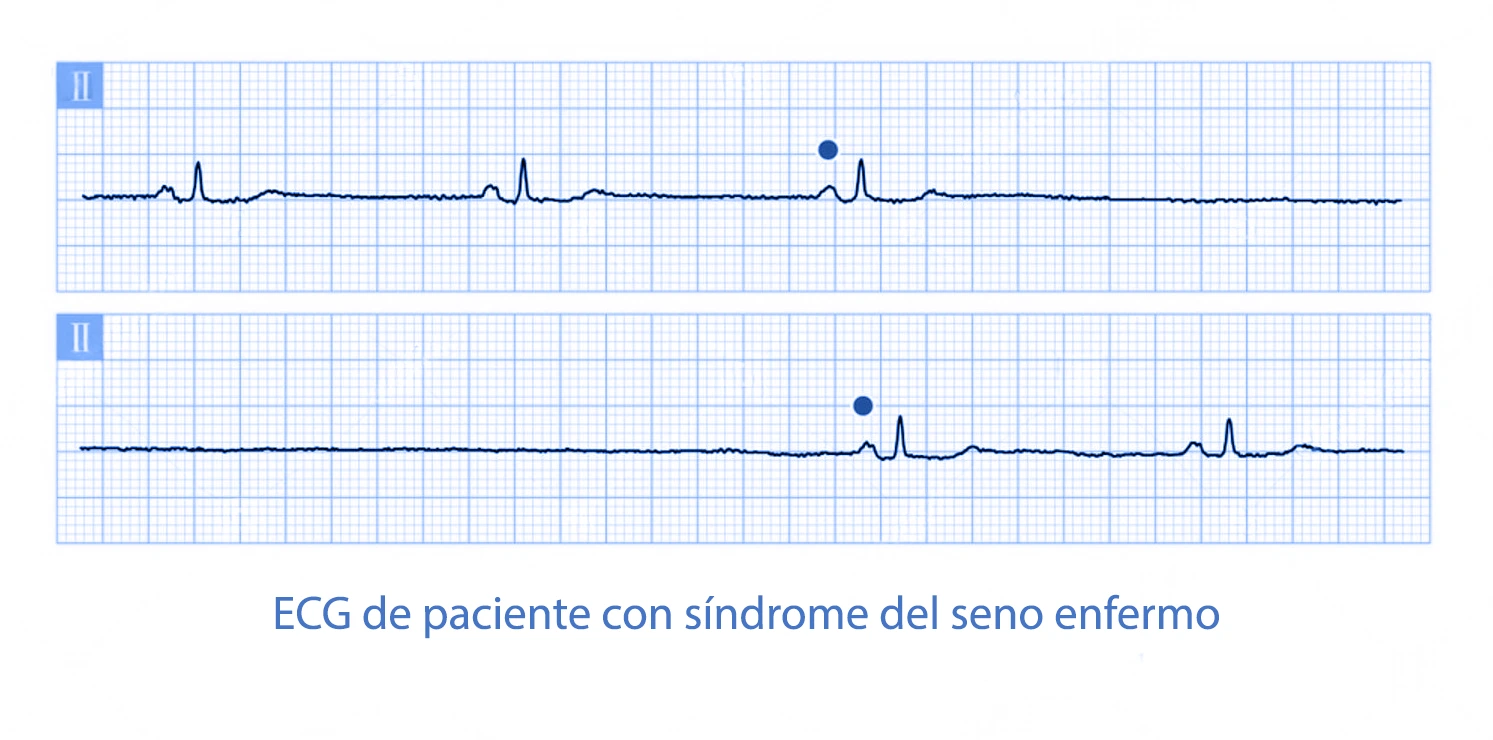
It’s important to rule out secondary causes such as medication use or metabolic disorders. Therefore, the diagnostic approach may also include blood tests and a thorough review of the patient’s medical history.
Treatment for sick sinus syndrome is tailored to the severity of the symptoms and the type of specific heart rhythm abnormalities present.
If the case is mild or the patient is asymptomatic, it may be enough to stop or adjust medications that depress the sinus node function. It is also essential to correct reversible causes, such as metabolic disorders from hypothyroidism or electrolyte imbalances.
However, when symptoms are significant, such as fainting, severe dizziness, or debilitating fatigue, a more definitive approach is required.
The placement of a permanent pacemaker is the most effective treatment for patients with sinus node dysfunction. This device monitors the heart rhythm and sends electrical impulses when it detects that the heart is beating too slowly or stops.
In most cases, dual-chamber pacemakers are used. They coordinate the activity between the atria and ventricles to maintain a physiological rhythm. This intervention not only relieves symptoms but also prevents serious complications such as falls or the progression of arrhythmias to more severe conditions.
At the Arrhythmia Clinic at ABC Medical Center, we can provide you with specialized care. Contact us!
How can we help you?
Ricardo can convey complex medical information in an accessible and friendly way so that all of our patients can understand and benefit from it. In addition, he has an empathetic approach, offering information and practical advice that really makes a difference in people's lives. #lifebringsustogether.
Learn more about Ricardo on LinkedIn
Pay in interest-free monthly installments in Specialty Centers, Check Ups, Diagnostic Tests, and Hospitalization
Get from 3 to 9 interest-free installments* with American Express or 6 installments* when paying with Banamex, BBVA, HSBC, Santander or 12 installments*
when paying with Banamex.
Contact us
Precision Medicine
Error: Contact form not found.
We help you
Send us your request and we will forward it to our specialists. We will get in touch with you very soon.
If you have preferred times to receive our call, please indicate them in your message.
Thank you for contacting us!
Interest-free
months in:
Interest-free
months in:
Specialty Centers
Diagnostic Studies
Check-ups
Hospitalization1
Choose from3 to 9 months when paying with American Express cards 2. Or
6 months when paying with your credit card3 Banamex, BBVA Bancomer, HSBC, Santander.
Or 12 months exclusively when paying with Banamex3
Valid until December 31, 2025. Promotions not cumulative. Subject to restrictions 1. In hospitalization, medical fees are not included. 2. Minimum amount: $1,500 for 3 to 6 months and $3,000 for 7 to 9 months 3. Minimum amount $1,500. (Cards issued abroad are not eligible).
Comparison of COVID-19 vaccines
Pfizer-
BioNTech
Pfizer-BioNTech
What is its effectiveness and what does it refer to?
Vaccine type: mRNA
Effectiveness: 95% after the second dose in the prevention of symptomatic COVID-19.
No Does not contain egg, latex, or preservatives.
How many doses are needed?
Two doses are needed, at least 21 days apart (or up to six weeks apart, if necessary).
Who should or shouldn’t get the vaccine?
People who should receive the vaccine are those over 16 years old.
People who should not receive the vaccine are those who have a history of anaphylactic shock (severe allergy) or who are allergic to any component of this vaccine such as polyethylene glycol (PEG) or polysorbate.
What are the possible side effects of the vaccine?
Pain where the injection was given, fatigue, headache, muscle pain, chills, joint pain, fever, nausea, malaise, and swollen lymph nodes.
How long will it take for me to be protected and what does it protect me from?
After 14 days of having the complete scheme (after the administration of the 2nd dose), the protection period is still under study. It protects us from serious COVID-19 or requiring hospitalization.
Moderna
What is its effectiveness and what does it refer to?
Vaccine type: mRNA
Effectiveness: 94.5% after the second dose in the prevention of symptomatic COVID-19.
Does not contain egg, latex, or preservatives.
How many doses are needed?
Two doses are needed, at least 28 days apart (or up to six weeks apart, if necessary).
Who should or shouldn’t get the vaccine?
People who should receive the vaccine are those over 18 years old.
People who should not receive the vaccine are those who have a history of anaphylactic shock (severe allergy) or who are allergic to any component of this vaccine.
What are the possible side effects of the vaccine?
Pain where the injection was given, fatigue, headache, muscle pain, chills, joint pain, fever, nausea, and swollen lymph nodes in the arm in which you received the injection.
How long will it take for me to be protected and what does it protect me from?
After 14 days of having the complete scheme (after the administration of the 2nd dose), the protection period is still under study. It protects us from serious COVID-19 or requiring hospitalization.
Janssen/
Johnson
& Johnson
Janssen/ Johnson & Johnson
What is its effectiveness and what does it refer to?
Vector-based vaccine.
Effectiveness: 72.0% in the prevention of symptomatic COVID-19.
85% in the prevention of severe COVID-19.
Does not contain egg, latex, or preservatives./strong>
How many doses are needed?
Only one dose in needed.
Who should or shouldn’t get the vaccine?
People who should receive the vaccine are those over 18 years old.
People who should not receive the vaccine are those who have a history of anaphylactic shock (severe allergy) or who are allergic to any component of this vaccine.
What are the possible side effects of the vaccine?
Pain where the injection was given, headache, fatigue, muscle pain, chills, fever, and nausea.
How long will it take for me to be protected and what does it protect me from?
After 28 days of having the complete scheme (the last dose applied), the protection period is still under study. It protects us from 85% serious COVID-19 or requiring hospitalization.
AstraZeneca
and
Oxford
University
AstraZeneca and Oxford University
What is its effectiveness and what does it refer to?
Adenovirus vector-based vaccine.
Effectiveness: 82% after the second dose in the prevention of symptomatic COVID-19.
How many doses are needed?
Two doses are needed, at least 56 days apart (or up to 84 days apart, if necessary).
Who should or shouldn’t get the vaccine?
People who should receive the vaccine are those over 18 years old.
People who should not receive the vaccine are those who have a history of anaphylactic shock (severe allergy) or who are allergic to any component of this vaccine.
What are the possible side effects of the vaccine?
Pain where the injection was given, fatigue, headache, myalgia, arthralgia, and fever, which were mild to moderate in intensity and disappeared within 48 hours of vaccination.
How long will it take for me to be protected and what does it protect me from?
After 14 days of having the complete scheme (after the administration of the 2nd dose), the protection period is still under study. It protects us from serious COVID-19 or requiring hospitalization.
Sputnik V
What is its effectiveness and what does it refer to?
Adenovirus vector-based vaccine.
Effectiveness: 92% after the second dose in the prevention of symptomatic COVID-19.
How many doses are needed?
Two doses are needed, at least 21 days apart (or up to six weeks apart, if necessary).
Who should or shouldn’t get the vaccine?
People who should receive the vaccine are those over 18 years old.
People who should not receive the vaccine are those who have a history of anaphylactic shock (severe allergy) or who are allergic to any component of this vaccine.
What are the possible side effects of the vaccine?
Pain where the injection was given, fatigue, headache, myalgia, arthralgia, and fever, which were mild to moderate in intensity and disappeared within 48 hours of vaccination.
How long will it take for me to be protected and what does it protect me from?
After 14 days of having the complete scheme (after the administration of the 2nd dose), the protection period is still under study. It protects us from serious COVID-19 or requiring hospitalization.
Anti-Herpes Zoster
Herpes zoster is a painful, burning rash. It usually appears on one part of the body and can last for several weeks. It can cause long-lasting severe pain and scarring. Bacterial skin infections, weakness, muscle paralysis, hearing or vision loss may occur less frequently. Herpes zoster is caused by the same virus that causes chickenpox. After you have had chickenpox, the virus that caused it remains in the body of nerve cells. Sometimes after many years, the virus becomes active again and causes herpes zoster.
Vaccination is indicated in the following cases:
Scheme type:
Rabies
Human rabies is a viral disease transmitted by the bite of an infected animal. It is characterized by acute encephalomyelitis (an aggressive response of the immune system that destroys the myelin layer of the nerves and alters its function at the level of the brain or spinal cord).
Vaccination is indicated in the following cases:
Scheme type:
There are two types.
1. Pre-exposure scheme, consists of three doses of rabies vaccine:
2. Post-exposure scheme, people not vaccinated against rabies, consists of five doses of rabies vaccine.
* If the individual continues to be at risk of exposure to the disease, revaccination should be considered.
Pneumococcal vaccines
Pneumococcal disease can cause serious infections in the lungs (pneumonia), the bloodstream (bacteremia), and the lining of the brain and spinal cord (meningitis).
Two vaccines help prevent pneumococcal disease:
Vaccination is indicated in the following cases:
Scheme type:
*One dose of Pneumococcal 13 vaccine should be given first, followed by one dose of Pneumococcal 23 vaccine, depending on your age and health.