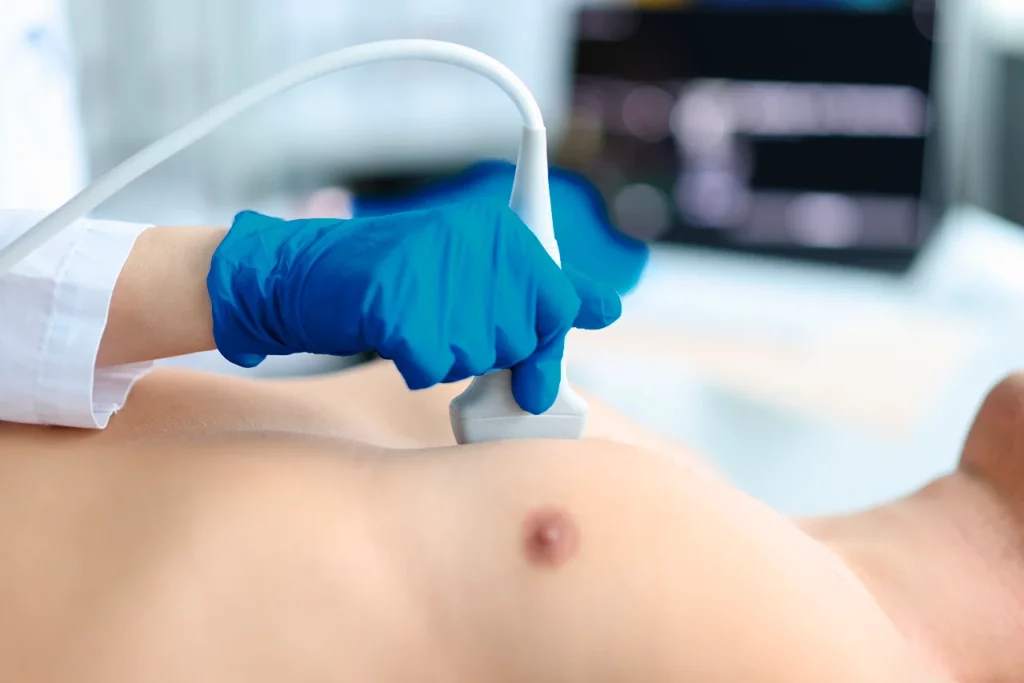
Echocardiography is an essential tool in the diagnosis and management of various cardiovascular diseases, thanks to its ability to assess the structure and function of the heart in real time. There are both adult and pediatric echocardiography, with each specialist having specific expertise based on the patient’s age. In cases involving pregnancy, fetal echocardiography is also available.
What is an Echocardiography
Echocardiography is a non-invasive test that uses ultrasound to obtain detailed images of the heart. It allows visualization of the heart chambers, valves, great vessels, and blood flow in real time, providing critical information about the patient’s cardiovascular health.
There are different types of echocardiography, depending on clinical needs:
- Transthoracic echocardiography: the most common type of echocardiography, where the transducer is placed on the chest to obtain heart images.
- Transesophageal echocardiography: the transducer is inserted through the esophagus to obtain clearer images of internal structures such as the heart valves.
- Stress echocardiography: performed before, during, and after physical exercise or medication-induced stress to evaluate how the heart responds to such conditions.
- Three-dimensional echocardiography: provides detailed 3D images, useful for planning surgical or interventional procedures.
- Cardiac Doppler: evaluates the speed and direction of blood flow, helping detect abnormalities such as stenosis or valvular insufficiency.
Echocardiographer
echocardiography is performed by a medical specialist known as an echocardiographer, who has the expertise required to interpret echocardiographic studies.
The echocardiographer’s responsibilities include performing the test, interpreting the images, generating reports, and collaborating with other specialists such as clinical cardiologists, cardiac surgeons, or intensivists to provide optimal patient care.
This specialist plays an essential role in cardiovascular health by diagnosing and monitoring a wide range of heart conditions such as valvular diseases, congenital heart defects, cardiomyopathies, heart failure, endocarditis, or coronary artery disease, among others.
Echocardiographic Views
A term frequently heard during an echocardiography consultation is echocardiographic views.
This term refers to the different planes or perspectives of the heart obtained during the test. These views enable the echocardiographer to systematically assess the various cardiac structures from multiple angles.
The main echocardiographic views are:
- Parasternal long-axis view: a longitudinal view of the left ventricle, left atrium, mitral valve, and aortic valve; used to measure wall thickness and assess valve function.
- Parasternal short-axis view: a transverse view of the heart showing papillary muscles, valves, and great vessels; essential for evaluating ejection fraction.
- Apical four-chamber view: provides a simultaneous view of all four heart chambers and is key to assessing both global and segmental heart function.
- Subcostal or subxiphoid view: the transducer is placed below the sternum, useful in patients with complex anatomy or when standard transthoracic views are limited.
- Suprasternal view: allows visualization of the great vessels and their branches; helpful for assessing aortic abnormalities.
- Transesophageal views: generate detailed images of the valves and left atrium, crucial for evaluating thrombi and septal defects.
Cardiac echocardiography is an indispensable technique for diagnosing, monitoring, and treating various cardiovascular diseases, making it a cornerstone of modern cardiology.
Echocardiographer Near Me
At the ABC Medical Center’s Cardiovascular Diagnostic Department, we have a team of highly trained specialists in echocardiography, dedicated to providing comprehensive and personalized care for all your cardiovascular needs.
Our echocardiographers in Mexico City are committed to your well-being and use the latest technology and advanced treatments to manage conditions such as coronary artery disease, congenital heart defects, valvular diseases, and more.
Fuentes:
Elsevier, MSD Manuals, Texas Heart Institute