
Lipoma: What It Is and When to Worry
A lipoma is typically a benign tumor made of fat. In most cases, it is non-cancerous, grows slowly, feels soft to the touch, and moves easily under the skin. Still, any lump that grows quickly, causes pain, becomes hard, stays fixed in place, or is accompanied by skin changes should be evaluated by a doctor to rule out other causes. Although finding a subcutaneous mass can be worrying, understanding its features helps you make timely decisions and achieve medical peace of mind.
What Is a Lipoma?
A lipoma is a type of tumor composed of adipose tissue and fat, making it one of the most common benign tumors in the human body. When referring to a benign lipoma, we mean a cluster of normal fat cells that remain contained within a specific area—usually right underneath the skin (subcutaneous)—without the ability to invade other organs or pose a threat to the patient’s life.
Generally, this type of fatty lump is characterized by remaining the same size for years or growing at an extremely slow and progressive pace. It does not alter normal body functions, and its impact is usually limited to local discomfort or aesthetic concerns, depending on where it develops.
Lipoma vs. "Fatty Lump": How to Recognize It
In everyday language, people often refer to this condition as a simple fatty lump or a small bump under the skin. In clinical practice, a lipoma is recognized during a physical examination by very specific characteristics:
- Consistency: It usually feels soft or rubbery to the touch, unlike bone tumors or dense cysts.
- Mobility: It moves or slides easily under the skin when gentle pressure is applied with the fingers; it does not feel attached to deeper tissue layers.
- Pain: As a general rule, it is completely painless, unless its location puts pressure on a nearby nerve or it contains numerous blood vessels.
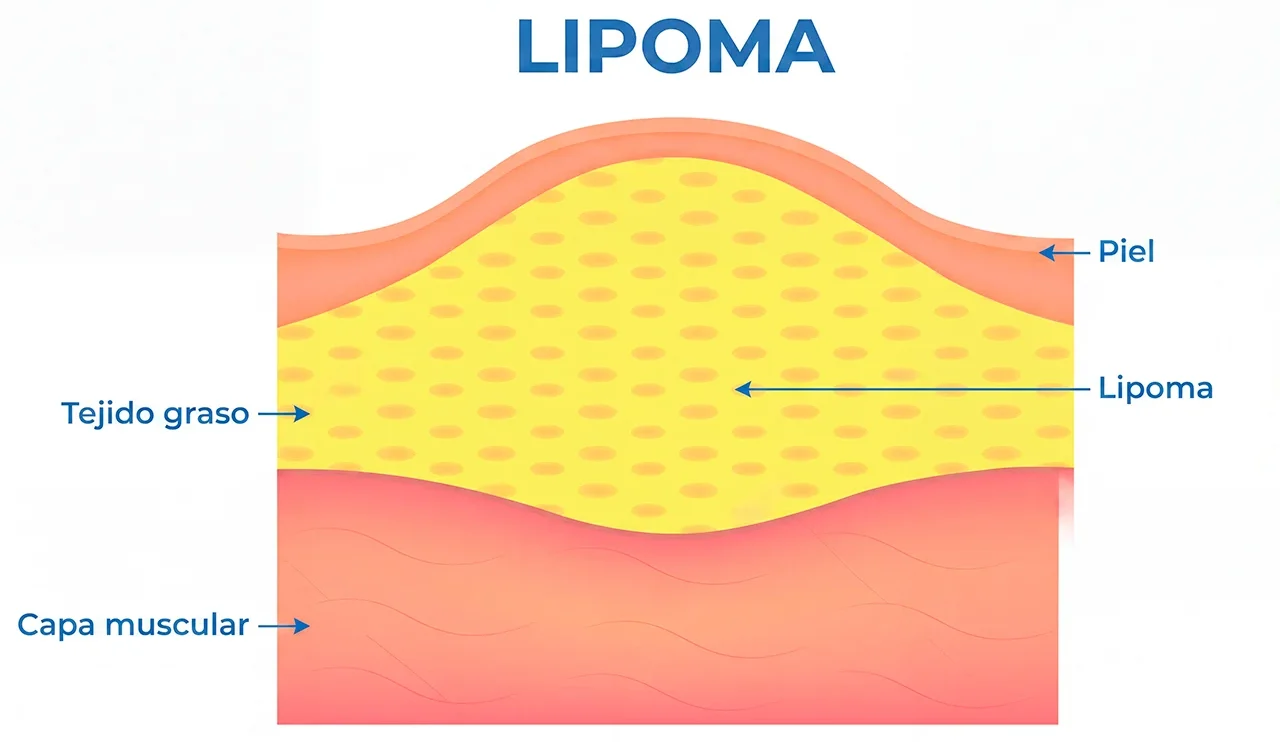
Although a lipoma can appear in virtually any part of the body containing adipose tissue, the most common locations for a fatty lump on the body include the neck, the nape of the neck, the back, arms, legs, or, less frequently, the face. It is common for patients to initially notice lumps in the neck and mistakenly assume they are swollen lymph nodes or muscle knots caused by stress, when they are actually fatty accumulations unrelated to tension.
Why Lipomas Form
One of the most frequent questions in medical consultations is what a lipoma is and why it appears. While its exact origin and the molecular mechanisms triggering this cell growth are not fully understood, medicine has identified several clear contributing factors:
- Genetics: There is a strong genetic predisposition. It is common for multiple lipomas to appear among members of the same family, suggesting an inherited trait in fat distribution.
- Local trauma: On occasion, a small fatty bump has been observed developing in areas that previously suffered trauma, a hard blow, or injury, although this link is not consistent in every case.
- Metabolism and hormones: Some studies suggest that certain metabolic shifts or hormonal fluctuations may contribute to their formation or sudden growth.
- Age: They occur most frequently in middle-aged adults, primarily affecting individuals between 40 and 60 years old.
At What Age Do Lipomas Appear?
This type of benign fatty tissue tumor can develop at any time in life, but the majority are diagnosed between the ages of 40 and 60. During these decades, factors such as the natural aging of adipose tissue, a lower metabolic rate, and hormonal changes directly influence lipid distribution and storage, alongside cumulative exposure to environmental factors.
It is relatively rare for lipomas to appear during childhood or adolescence. In cases where a child or teenager develops a lipoma, it is usually strongly linked to direct genetic factors or specific medical syndromes (such as familial multiple lipomatosis) that predispose the body to these growths.
In older adults, existing lipomas may become much more visible and noticeable to the naked eye. This is not because they grow faster, but rather due to the general loss of subcutaneous fat and thin skin associated with natural aging. Nevertheless, the rate at which new lipomas appear drops significantly in advanced age.
Can a Lipoma Be Cancerous?
The short, categorical answer is no: a lipoma is, by definition, a benign tumor and does not turn into cancer over time. However, legitimate clinical concern arises because the medical term "tumor" is often mistakenly associated with malignancy, and because other lesions can mimic its initial appearance.
It is very common to see search terms like "malignant lipoma symptoms". Clinically, that combination of words is incorrect; the proper medical term for a malignant tumor originating in fat cells is a liposarcoma. Liposarcoma is a variant of soft tissue sarcoma that, unlike a benign lipoma, is a cancerous condition requiring immediate and specialized oncological care. For this reason, if you notice any new fatty lump or bump on your body, it is essential not to self-diagnose and instead seek a professional evaluation to confirm it is benign.
Red Flags in a Fatty Lump or Bump
To help distinguish a common lipoma from a lesion that might require urgent attention or suggest a liposarcoma, pay close attention to the following warning signs. Seek a prompt medical evaluation if the lump exhibits any of these characteristics:
- Rapid growth: Increases significantly in size over a few weeks or months, unlike the slow progression of a typical lipoma.
- Pain or tenderness: Becomes spontaneously painful or feels very tender to continuous touch.
- Hard or firm consistency: Loses its characteristic soft texture and feels rigid, stony, or dense.
- Fixed to surrounding tissue: Feels stuck and does not slip or move under the skin when you try to palpate it.
- Skin changes: The skin over the lump becomes red, thick, ulcerated, warm, or discolored.
- Deep location: Feels like a deep mass under the muscles, rather than immediately beneath the skin on the leg, arm, or back.
- Nerve compression symptoms: Causes numbness, tingling, or weakness in a limb due to pressure on nearby nerve or vascular structures.
How a Lipoma Is Diagnosed
To reach a definitive and accurate medical diagnosis, specialists follow a standardized protocol starting in the office:
- Physical exam and medical history: The doctor will carefully palpate the mass to evaluate its size, consistency, mobility, depth, and rule out pain. They will also ask about how long you have had it and your family history.
- Imaging studies: For large lipomas (greater than 5 centimeters / 2 inches), those suspected to be located deeper than usual, or those showing atypical features, a soft tissue ultrasound or MRI will be ordered. These imaging tests show the exact boundaries of the fat deposit and its relationship to surrounding muscles.
- Lipoma biopsy: If lingering doubts about the true nature or benign status of the lump remain after physical and imaging exams, a biopsy (removing a small tissue sample) will be required for histopathological laboratory analysis to confirm the diagnosis beyond a doubt.
What Doctor Should I See for a Lipoma?
Patients often do not know which specialist to consult when they discover an unusual lump. The recommended care path includes:
- Primary Care Physician / General Practitioner: The appropriate first step to evaluate the tumor. They have the expertise to conduct an initial physical exam and determine whether it appears to be a lipoma or requires referral.
- Dermatologist: As specialists in skin and subcutaneous tissue conditions, dermatologists possess the clinical expertise for both advanced diagnosis and office-based care, including performing biopsies if needed.
- General Surgeon or Plastic Surgeon: If the lump has been confirmed as a lipoma and you choose to have it removed, general or plastic surgeons are the qualified specialists to perform the excision, ensuring anatomical safety while prioritizing cosmetic outcomes.
Lipoma Treatment: When Removal Is Recommended
Once a diagnosis is confirmed, treatment options vary and are personalized to each case. It is important to emphasize that, because they are benign, the vast majority of lipomas do not require mandatory treatment.
If the lipoma is small, painless, and causes no physical or cosmetic concern, the standard medical approach is simply periodic observation. This involves occasional checkups to confirm that it remains stable and shows no negative changes over time.
Conversely, surgical removal (lipoma excision) is recommended when the lesion causes chronic pain, restricts joint movement, grows rapidly, or causes significant aesthetic discomfort. It is a simple outpatient procedure performed under local anesthesia, where the entire fatty capsule is removed to prevent it from growing back.
In very specific scenarios, alternative options exist:
- Liposuction: May be considered when a lipoma is large, very soft, and located where a large surgical scar is undesirable. However, it carries a slightly higher risk of recurrence if cellular remnants are left behind.
- Steroid injections: Rarely used, these do not eliminate the lipoma entirely, but they can significantly shrink the size of the fatty lump by causing localized adipose tissue atrophy.
The final choice of procedure always depends on a careful medical evaluation considering the lump’s size, depth, anatomical location, and individual health preferences.
In conclusion, lipomas are benign fatty tissue tumors that pose no threat to overall health. Monitoring their features in an informed way and seeing a doctor if drastic changes occur are your best tools for maintaining well-being and peace of mind.
Need Specialized Care?
The Internal Medicine department at Centro Médico ABC is ready to assist you. Contact us today!
Disclaimer: The content of this material is for informational purposes only and does not, under any circumstances, replace a consultation with a medical specialist. Centro Médico ABC assumes no liability for alternative uses of this information. If you require further medical advice, please consult your trusted specialist directly.
Frequently Asked Questions
Fuentes: MSD Manuals, Cigna, Scielo