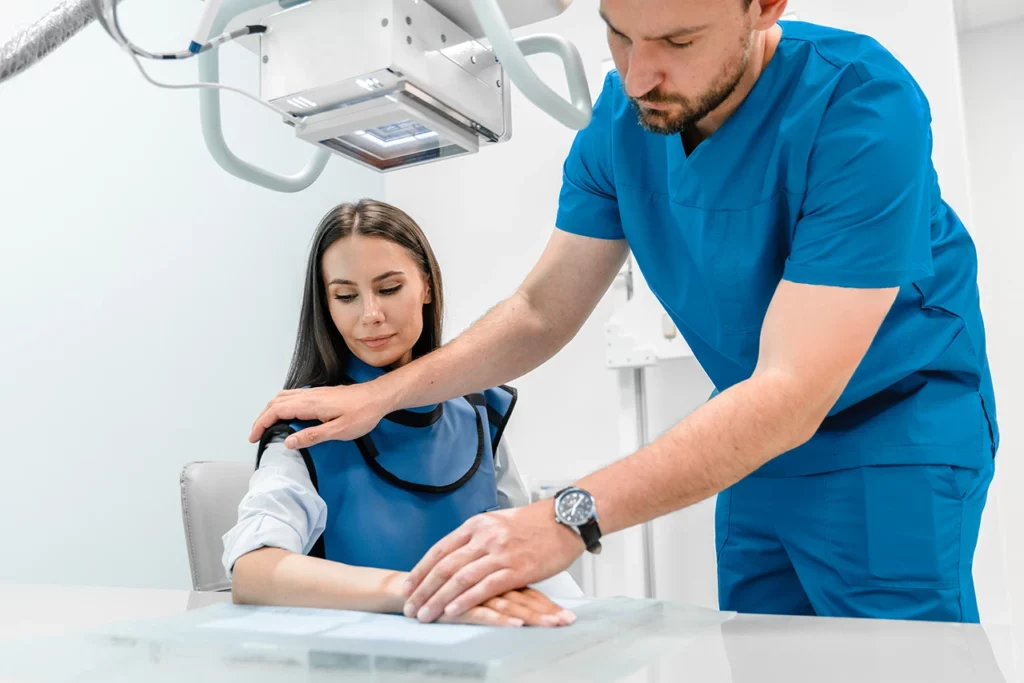
Musculoskeletal radiology is a medical subspecialty focused on the diagnosis and monitoring of diseases and injuries that affect the musculoskeletal system.
The musculoskeletal system comprises bones, muscles, joints, tendons, ligaments, and connective tissues.
With a wide range of diagnostic tools, musculoskeletal radiology offers multiple options for identifying structural abnormalities, evaluating inflammatory processes, detecting tumors, and monitoring treatment responses.
Magnetic resonance imaging (MRI)
MRI is one of the most advanced tools within musculoskeletal radiology. It uses a powerful magnetic field and radio waves to generate detailed images of soft tissues such as muscles, tendons, ligaments, and cartilage.
It is useful for evaluating sports injuries, joint diseases, tumors, and nerve compressions.
PET/CT
Positron emission tomography combined with computed tomography, also known as PET/CT, merges metabolic imaging with detailed anatomy. In the context of the musculoskeletal system, it is invaluable for detecting bone tumors, evaluating infections such as osteomyelitis, and monitoring cancer.
PET/CT is notable for detecting metabolic changes before they become visible on other techniques, providing an early and more accurate diagnosis in complex diseases.
X-rays
X-rays are the most common and widely accessible tool for musculoskeletal imaging. By using ionizing radiation, they produce two-dimensional images of bones and joints.
They are especially used for diagnosing fractures, arthritis, or congenital malformations. Although its resolution is limited compared to other imaging tools, particularly for soft tissues, it serves as an initial tool in musculoskeletal evaluation.
Musculoskeletal ultrasound
Musculoskeletal ultrasound is a non-invasive technique that uses sound waves to evaluate muscles, tendons, and superficial tissues. It is particularly useful for identifying soft tissue injuries such as tendon tears or bursitis.
It also enables dynamic evaluation of structural movement in real time and guides image-assisted procedures, such as joint aspirations or inflammation treatments.
Bone scintigraphy
Bone scintigraphy is a nuclear medicine study that uses radioactive tracers to detect areas of increased bone metabolism.
It is used to detect bone metastases, evaluate infections, and diagnose metabolic diseases.
Although it does not provide detailed anatomical images, its sensitivity makes it essential for detecting metabolic abnormalities in various scenarios.
Arthrography
Arthrography is a musculoskeletal radiologic technique in which contrast medium is injected into a joint, allowing visualization of joint structures on X-rays, CT, or MRI.
It is particularly useful for evaluating joint injuries, checking prosthetic integrity, and diagnosing intra-articular problems.
Computed tomography (CT)
CT uses X-rays to generate cross-sectional images of the body, providing more detail than conventional X-rays.
It is ideal for evaluating complex fractures, especially in areas such as the spine or pelvis; for detecting small bone lesions; and for guiding invasive procedures such as bone biopsy.
Bone densitometry study
Bone densitometry measures bone mineral density and evaluates the patient’s bone health. It is fundamental for diagnosing osteoporosis, monitoring treatment in patients with metabolic bone diseases, and assessing bone density in specific conditions such as hyperparathyroidism.
Musculoskeletal radiology plays a key role in diagnosing and managing a wide range of conditions that affect the musculoskeletal system.
Depending on each patient’s characteristics, one or more of these tools may be required.
Radiologists near me
At the ABC Medical Center’s Radiology and Molecular Imaging Department, our team of musculoskeletal imaging specialists is highly skilled and committed to delivering comprehensive, personalized care tailored to all your imaging needs.
Our radiologists in Mexico City are committed to your well-being and use the latest technology and most advanced techniques to manage conditions such as fracture diagnosis, soft tissue injury evaluation, tumor detection, and more.
Fuentes:
MedlinePlus, Secretaría de Salud, NIH